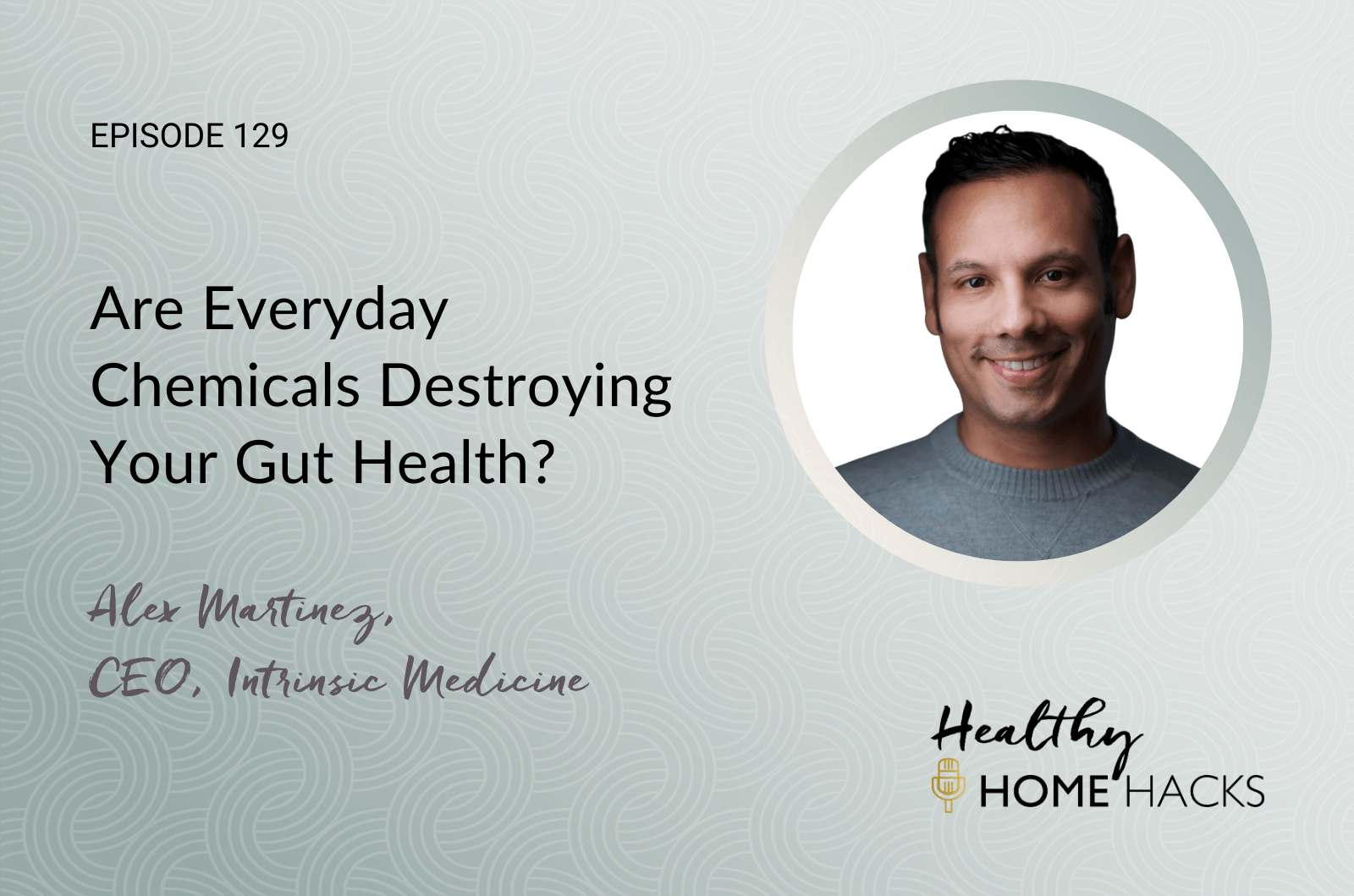

Over 70% of Americans are dealing with digestive issues right now. And it’s getting worse—inflammatory bowel diseases have jumped 50% in just two decades. The real culprits might not be in your fridge—they’re under your sink, in your garage, and all over your lawn. Everyday chemicals. Pesticides. Cleaning products. New research shows these aren’t just sitting on surfaces—they’re getting into our bodies and disrupting the beneficial bacteria in our gut. And when those bacteria go down, everything falls apart—weakened immunity, mental health issues, chronic inflammation, and even antibiotic resistance. The gut-brain connection alone affects 1 in 5 adults dealing with anxiety and depression—and scientists are finding direct links to microbiome disruption.
Our guest, Alex Martinez, CEO of Intrinsic Medicine, is a leading gut-brain expert. He’s breaking down the science and giving us practical steps to protect ourselves.
KEY TAKEAWAYS
- The mechanism by which pesticides and industrial chemicals disrupt beneficial gut bacteria—and what’s actually happening at a biological level
- The link between chemical exposures and antibiotic resistance
- How the Gut-Brain Axis (GBA) may damage our gut microbiome and influence overall health
- Beyond immediate digestive issues, the long-term health implications of gut dysbiosis
- Available treatments that can help remedy chronic illnesses impacted by disruptions to the gut microbiome
- Preventative measures to help people safeguard the gut microbiome from potentially harmful external factors in our homes and environments
EPISODE LINKS
- To learn more about Alex’s research and clinical trials, visit: intrinsicmedicine.com
Listen to all episodes of Healthy Home Hacks on your favorite podcast app
iTunes Spotify
Rate, Review, and subscribe on Apple Podcasts
“I love Ron & Lisa and Healthy Home Hacks.” <– If that sounds like you, please consider rating and reviewing our new show! This helps us support more people — just like you — to regain their health, protect their loved ones, and enjoy more energy. Click here, scroll to the bottom, tap to rate with five stars, and select “Write a Review.” Then be sure to let us know what you loved most about this episode or the entire show.
Additionally, if you haven’t already done so, please subscribe to the podcast. Subscribe now!
As always, we appreciate you subscribing to the Healthy Home Hacks podcast and taking the time to leave a review. Five stars are always appreciated if you find our show useful or just plain entertaining. Until next time – stay healthy!
FOLLOW RON AND LISA:
RonandLisa on Instagram https://www.instagram.com/ronandlisa/
RonandLisa on TikTok https://www.tiktok.com/@ron_lisa
RonandLisa Healthy Living Store https://shop.ronandlisa.com/
(00:05) How would you like to improve your health and keep your family safe? You're listening to the Healthy Home Hacks podcast, where we firmly believe enjoying optimal health shouldn't be a luxury. Healthy Home Authorities and husband and wife team, Ron and Lisa, will help you create a home environment that will level up your health.
Enter your name and email address below and I'll send you periodic updates about the podcast.
(00:25) It's time to hear from the experts. Listen in on honest conversations and gain the best tips and advice. If you're ready to dive in and improve your well-being and increase your energy, you're in the right place. All right, here are your hosts. Bow biologists, authors, media darlings, vicarious vegans, and avocado afficionados, Ron and Lisa Bareris.
(00:50) Are you overexperiencing embarrassing gas, bloating, constipation, or other digestive woes? Well, you're not alone. Did you know 70% of Americans are dealing with digestive issues right now? And guys, it's getting worse. Inflammatory bowel diseases have jumped 50% in just two decades. Something isn't right.
(01:14) The gut brain connection alone affects one in five adults. How would you like to improve digestive wellness and overall gut health in just 12 weeks? Grab our must-have resources for busy people. Head over to bron andlisa.info/gut. That's ronandlisa.info/gut. You're welcome. Welcome back to the show everyone. I'm Lisa >> and I'm Ron.
(01:42) And here's a stat that should shock you. Over 70% of Americans are dealing with digestive issues right now, and it's getting worse. Inflammatory bowel diseases have jumped 50% in just two decades. >> So, what changed? The real culprits might not be in your fridge. They're under your sink, in your garage, and all over your lot.
(02:05) everyday chemicals, pesticides, cleaning products. New research shows these aren't just sitting on surfaces. They're getting into our bodies and disrupting the beneficial bacteria in our gut. >> And when those bacteria go down, everything falls apart. Weakened immunity, mental health issues, chronic inflammation, even antibiotic resistance.
(02:29) The gut brain connection alone affects one in five adults dealing with anxiety and depression. And scientists are finding direct links to microbiome disruption. >> So today, how are these hidden chemicals undermining our gut health? What everyday products are the worst offenders? And what can you actually do about it? We've brought a leading gut brain expert to break down the science and give us practical steps to protect ourselves.
(02:59) >> Whether you're dealing with gut issues or just want to understand what's happening inside your body when you spray that counter cleaner, >> stay with us. What you're about to learn can change how you think about health forever. Our guest, Alex Martinez, CEO, and co-founder of Intrinsic Medicine, is a patient, entrepreneur, business adviser, and healthc care industry leader committed to transforming how gut brain immune access disorders are diagnosed and treated.
(03:30) >> Alex co-founded Intrinsic Medicine, aiming to leverage human milk biology. You heard that right. To transform diseases caused by immune and microbiome dysregulation, including Parkinson's disease, juvenile idiopathic arthritis, IBS, IBD, autism spectrum disorder, and other gea disorders. >> A prior associate attorney, Alex received his jurist doctor from the University of Michigan Law School and his Bachelor of Arts in Health and Societies.
(04:05) Without further ado, welcome to the show, Alex. Yes. >> Awesome. Thanks for having me. I love the energy. So, >> thank you for being with us. We're excited. This is a hot topic. Probably every single person listening has had some kind of gut microbiome issue or is dealing one with one now. >> So, we are thrilled that you're here. And were you going to say something? I was gonna go right into questions because I know everyone's chomping at the bit.
(04:33) >> No, I I was actually sort of laughing at your your nice introduction. Who knew when I was in law school that I would be here today, >> right? >> Educating people about how cleaning their kitchens and >> themselves is actually impacting their gut and overall health. Right. >> Yeah. >> So, Alex, this was not your dream as a 5-year-old boy to do.
(04:59) No, >> actually as a 5-year-old maybe. Right. Because like five-year-olds are interested in >> germs getting dirty. >> Yeah. >> Right. Like like it's all interesting. So >> maybe not 10year-old, but 5-year-old. >> Yeah. Maybe >> probably close. >> It's interesting, Alex, because similar with me, I was an interior designer and I got sick from toxins in a newly remodeled home.
(05:24) And you know, I know we're going to get into a lot of that, like how these are affecting our gut microbiome, and that's something you don't hear much about at all. So, let's just start off. Can you explain the mechanism by which pesticides and industrial chemicals disrupt our beneficial gut bacteria? And what is actually happening on a biological level? >> So, I'll just like I'll keep it simple, right? It's it's the same thing that those do to the macroecologies.
(05:51) And what I mean by that is like where are the bees, where are the birds, >> where are the insects, right? >> We know that all of those industrial, you know, look at the fish, look at the frogs, the amphibians. >> Yeah. >> Look at what those do to those organisms. Well, in a smaller dynamic, but no less important and much closer to home, those same compounds are doing that to the ecology of the microbiome that's on us and inside of us, >> right? It's crazy.
(06:29) It's funny how people don't make that connection. You know, we know the bees are the dying of the bees and all the weird things happening with wildlife with their, you know, endocrine disrupting chemicals that are changing the sexual orientation of frogs and bass and all of these, you know, animals that they've proven due to these chemical exposures.
(06:52) And yet, we don't really think about it as us as like, yeah, that's going to affect us the same way, too. >> Yeah. And that's that's part of like what we're trying to do here. And so like on like on a direct mechanistic basis is that is that we have a concept of hygiene that ignores nature. >> Yes. Right. >> An ecology, right? And so we have to think about microbes and bacteria, right? Instead of this germ theory, oh my gosh, a germ is so bad.
(07:24) It's the same thing. A wolf is a keystone predator, right? is in the right situation. It keeps everything in balance, but you don't put it on a sheep ranch. Right. Right. >> Because it causes disruption. Right. >> Right. >> And so when we think about it, it's about it's a balance of these different, you know, microbial actors, right? And how we're disrupting them.
(07:51) And you know that's what what's interesting is that this interplay has a direct effect on on our health and well-being. And so you know for example like the most important bacteria in our guts are are the bifidobacteria. >> What is it called again? Alex bifanol. >> Bifido bacteria. >> Okay. >> And it's and it's like it's it's this is like a large family bacterium.
(08:18) There's all these different subspecies. They're ones that that are there at different stages of life. I actually think about them as like kind of like the American bison like the buffalo, right? If you think about just as an ecological reference and these are the fundamental symbiote. This is like when we're born, if we're not a C-section baby, our mother inoculates us with us, blesses us with these healthy, beneficial bacteria.
(08:46) And then her milk has special sugars that specifically nurture this. And these bacterias are like, they're our first line of defense. Like it's time for us to think about the microbiome >> as an acquired immune system, right? They're like our allies just covering us. And it's important to remember our gut is actually where we take the outside in. Okay.
(09:18) So it's a it's a very vulnerable point. So in some ways I think from all the way from the skin all the way to the internal think about it as a it is a continuous barrier and so we want microbes there who are essentially making sure the first pass is done and that every that everything is um >> so we have a symbiotic relationship with them and then when the environment interferes with that so from glyphosate or something that we eat and it destroys some of this good bacteria in our gut, that's where the problems occur. Right.
(09:52) >> Bingo. And because glyphosphate is like it's basically an antibiotic for bifidos, right? >> Okay. >> Okay. So, give listeners some practical things right now that are harming their gut that they probably may or may not be aware of. What What are like five of the worst things that you can expose yourself to that are bad for your gut? >> I mean, the easy one's alcohol.
(10:16) >> Alcohol. Yep. >> Yeah. Just strip that one away. >> So, is it all alcohol or is it even like wines, too? >> Yeah. >> Red wine. Red wine as well. Okay. >> Yeah. I mean, it's always going to cause some disruption. >> Alex, you ruined our Saturday night. This makes >> I know. I I know. I know. Hate to be a buzzkill.
(10:37) >> Well, do you believe in moderation with it? I mean, alcohol in moderation as long as you're >> So, it's interesting. I think was this is what's really important like and this is what I try to like leave with people is we've all done the quantified self thing right we all have the aura rings we all track everything those are merely tools like catch yourself do you wake up and look at your sleep score and then decide how your sleep was >> no >> not me >> exactly exactly no I wouldn't I wouldn't think you we would do that but but this
(11:13) this epiphany came when I was doing it and it really was using it as a tool to basically study myself and >> not change anything just study what is right >> yeah study my baseline but then also like when I had a single alcoholic drink like I had a sleep disturbance >> yeah so these are tools for us to generate self-awareness right and what's important is I believe in personal sovereignty so like you should do it like look if I was drinking wine get some delicious just biodnamic wine like so the the beauty of it. So this is
(11:47) actually the cool thing is what is wine? >> Fermented grapes. Yeah. >> It's a it's a byproduct of microbes, right? There is a symbiosis, right? They took those compounds and the alcohol is actually what rate limits the reaction is actually what keeps the bacteria from consuming everything. Right? So that's what that's what establishes the homeostasis.
(12:14) And so why many of those like wonderful studies saying hey look wine's actually good for you works is because those bacteria created metabolites and those metabolites are the flavors the nuance that be have and guess what benefit is probably more than it impacts you right so it's a tradeoff so again this is if somebody's having gut problems I would say eliminate that factor and then we can talk about some other things that you could do and then if that's important for you socially or culturally sure add it on >> but build up the capacity. So let's talk
(12:54) about some like other things like the honestly the biggest one is like stress like >> that's why we have Alex that's why we drink the red wine. >> Yeah. Yes. That is the paradox right? So, you know, chronic stress certainly is is one of those things. What else? >> Sugar. Sugar. >> Sugar. >> Sugar. >> Yeah, processed sugar is a major one.
(13:19) I think one of the conversations we also really need to have and this is like where labeling transparency is so important is that like I know a lot of people are going more plant-based. When you go highly processed plantbased, >> right? >> If it if it was done in industrialized farming, >> guess what you're being exposed to, Lisa? What are >> pesticides, glyphosate? >> Yes.
(13:45) All of it. Yeah. >> Exactly. So, so that may be one of these things. So, I recommend everyone like, you know, find usually a functional or naturopathic practitioner and do do an elimination >> elimination diet. Yeah. Yes. Yes. >> I did want to say you put a little rain on our parade, Alex, because today is our 10year veganversary.
(14:07) >> Yes. >> 10 years vegan. But we are we we when we started, we were just like you said, we were buying all the processed foods because back then there really wasn't as good of options. And number two, you couldn't get everything organic. So it' be like soy this and soy that and soy this, soy ice cream, soy, you know, >> everything. And we're not that way now.
(14:26) We're very organic, plant-based. And you know, you have to learn how to be a good vegan. How to be a good plant-based. Just because you're vegan doesn't make you healthy, you know. >> Exactly. It is. And and congratulations on that, by the way. >> Thank you. >> Thank you. >> Welcome to the party. Right.
(14:43) So, are you not vegan, Alex? Or you're going to be today, right? >> What's interesting is I largely try not to eat animals. >> Yeah. >> I won't eat an animal unless it had a life. I wouldn't mind being reincarnated as let's just say that. >> Oh, which animal would that be? A dolphin. >> So, so, so, so think about buffalo meat in regenerative farming.
(15:09) >> Okay. >> settings. Axis deer that are cold because they're an invasive species but are living in a, you know, a high stress area. >> Salmon because they swim upstream to their death. Right. >> Yeah. So, with fish, it's what I catch. I am a spearfish. So I'll I'll go and Oh, wow. You know, and >> again, it's a very approximate connection.
(15:32) >> Is it a spear gun that you use? >> We saw some people on the beach last weekend doing that. Yeah. >> Yeah. Yeah. I'm a I'm a free diver. So, yeah. Spent a lot of time down there. And I think that's also one of the the important things here is that like this is how this all interconnects. That's part of being in like I'm entering the ecological system, right, as a predator as as a predator and I'm also not the top of the food chain.
(16:03) I'm >> you know not advanced, you know, in my capabilities and I'm selective and and I'm part of the process. And if you think about us ancestrally, think about all the processes. So if I'm bringing the fish out, if I'm getting the vegetables out, if I'm digging the roots out with my hands, I'm actually curating a microbiome from what I'm consuming that's becoming part of me.
(16:34) It's becoming it. So this is an interface by which it's an invisible interface by which we're communicating with our environment. Well, and like the Hawaiians, they are very big on blessing the life of an animal when they have it for sale out or something. >> They will do like a cere. And I think that's really because part of why we're vegan is obviously animal welfare >> a big part of it.
(17:02) And we don't want to harm animals. We don't want to be a part of that. So I think like the honoring the animal welfare part of it is a really big thing. like not just eating unconsciously but consciously choosing you know and being aware and whoever you want to eat meat that's your decision but being conscious aware of all of that and how it affects >> that's so important Lisa because I in some ways the obesity epidemic is the other side of an industrialized animal cruelty >> paradigm right because >> it's right like think about that
(17:38) principle I just said like >> would you mind being the animal that you just consumed living a life like have a chance to reproduce right like >> not even not even being able to be on grass not even being able to have your child taken away I mean they do that with the cows the milk and cows and >> and pigs and that and it's really if people saw you know they wouldn't be they wouldn't want to be a part of it I think people just go out of sight out of mind oh like a little perfect piece of deli meat it didn't must have not come
(18:07) from an animal, you know, in a factory farm. >> Exactly. And that's and that's why like as I shared with you and thank you for being open-minded with me is that like yeah, I live it right. I had that experience. I feel I feel a loss, right, as I'm getting the gift from the animal. And one of the things that that's I'll share it with you because, you know, thank you for sharing more with me.
(18:32) One of the things I observed in how I hunt is that, you know, I'll go down in a school, I don't choose the fish, the fish chooses me. If that makes sense. >> Yeah. >> A fish knows I'm there as a predator and sacrifices itself for its school. It's interesting. >> Interesting. >> I'm I'm not pointing.
(18:51) It swims in front of >> Interesting. >> Wow. So, and that's that's part of just being in the flow state. And that's when you know you're there and you know that you're and that's when you know you've been welcomed the ecosystem. >> And so that's really kind of how I think about all of this stuff, right? And so >> when we think about the microbiome, >> it's thinking about yourself as a planet. We are a planet, right? Mhm.
(19:15) >> And we have these cells that have their own circadian rhythm and every single day they wake up >> and then guess what? They have a bunch of these symbiots that they work with, right? >> Yeah. >> And what we're doing with what we consider classical hygiene is we're really disrupting that other side, which is the interface between us and nature.
(19:42) >> Would you say coffee is a no no too? Going back to that, how do you feel about caffeine? How does that affect the gut microbiome? >> Yeah. So, I prefer to do like green teas. I I think you can get so much more from teas. The epiatakans and them are like are very good for your gut, right? So, so basic basically it's like why would you not? >> But if you like coffees, you know, >> you think it's fine whether it's caffeine caffeinated or not.
(20:09) I mean that that's a whole another show because within the coffee we've got like the the Starbucks junk there's different levels of how you can drink coffee like >> I say the biggest thing if you want to drink coffee you just may have to make sure there's no micotoxin on it that micotoxin will destroy your gut destroy your health like so just >> thank you for saying that I we have a blog post on that with all the our picks for the top organic mold-free micotoxin free >> third party tested coffees and yeah you're going to pay a little more. But
(20:38) trust me, you're paying more at Starbucks. You're paying a lot more at Starbucks for crappy coffee that's an art organic that you know is going to be loaded with who knows what kind of sugar and flavors. So yeah, I think just that simple change can really make a difference in how you feel. >> Probably a good segway for our next question.
(20:57) So the research suggests, Alex, a link between these chemical exposures and antibiotic resistance. So given the gut brain connection known as the gut brain access, how might damage to our gut microbiome influence overall health? >> Yeah. So I the way I really like to present it is that just gut health equals human health, right? Dead stop.
(21:19) We've known this for thousands of years. It's why Hypocrates said all diseases start in the gut. Like literally like we're not inventing anything new. We're just remembering >> going back to >> Yeah. >> who it was originally. Yeah. >> And what's the most important thing to think about is our brain here is probably not our first brain, right? Is is funny.
(21:42) People talk about the entic or the gut nervous system as the second brain. I think it's the first brain. >> Like your gut instinct, right? Your do you think you'll have better gut instinct with a healthy gut? That's interesting. >> Yeah. So think about what from an evolutionary perspective like what is our GI tract? You know, mouth to anus.
(21:59) It's a worm. Okay. >> The whole thing's a worm. >> I know. I know. I know. I know. Sorry. >> I need no more worms. >> It's like it's a crazy one, but it's a crazy thought experiment, but if you take out the GI system, it is a segmented worm, right? >> Oh, that it looks like a worm. >> So, if you go back, you know, a billion years or so, right? You go all the way back in evolution, it was a worm, right? like an early multisellular organism that hooked up with the symbiotes, right? They said, "Hey, we want to be
(22:33) our own thing, right? We don't want to be we don't want to be single-sellled anymore." And they said, "Hey, well, you know what? We can we can help you. You're still going to be open on these ends. We'll protect you on the inside." So, that's our our GI tract. Then you had neurons developing from that to help direct the organism.
(22:55) So in some ways I think our gut is as you said Lisa right our gut sense it's the primordial brain right it's >> it's smarter than the brain what's that famous Albert Einstein quote does anyone know what I'm talking about where something about fish like he your gut he talks about how your instinct is your actual genius not your not your mental capacity right it's a it's a cool quote and it's true if you actually trust your gut and let it lead you more than your brain It'll lead you better.
(23:24) >> Yeah, >> it really does. Yeah. It'll keep you from danger, right? You get that feeling like something's not right about this person or something's not right about that that alley that >> and so so it's and so what's interesting is that our gut has a has the red telephone line directly to the brain. It's called the Vegas nerve.
(23:43) >> The Vegas nerve. Okay. This just came up not to get all into this topic, but did you see in the Epstein files? There was all this uh conversation with Epstein about the Vegas nerve. Did you see those emails by any chance? >> I haven't seen those ones. I did look at a he was very interested in the microbiome and and and feal micro microbial transplant.
(24:07) So, >> yeah. >> Yeah, >> we'll just leave that at that. But I thought the Vegas nerve was interesting that that >> that is very interesting. And also getting back to your analogy of how the GI tract really were just a giant worm from mouth to anus, right? Yeah. At first I was at first I was disgusted, right? When I thought about it, we could have been >> we could be an octopus, right? I think octopus is their mouth and anus is the same thing.
(24:30) >> Right. So, aren't we so blessed right now? >> Yeah. >> Okay. No, I'm moving on. >> Okay. Very good. Um, well, no, something fascinating to me because what is the percentage of serotonin that's from our gut? >> Oh, it's like it's like 80% or something. >> 80%, right? 80% for your listeners who never heard that.
(24:50) That's pretty shocking when you hear that. Like the majority of our serotonin in our body, it comes from our gut. >> So, this gut brain access and this link to depression and children that are having all of these behavioral disorders, what do you say about that? Like, you know, cuz it's sky. I mean, I grew up.
(25:08) I didn't know one person with ADHD or behavioral disorder or even a gut disorder. I didn't know one child. And I'm sure everyone in our generation and older can say the same thing, right? >> Yeah. They're I mean, they're they're almost all gut mediated. I mean, we're we're finding relationships and really everything.
(25:27) I mean the behavioral stuff, autism, the I mean even things as as seemingly distinct as rheumatoid arthritis, >> patients have a distinct >> gut microbiome signature. Yeah. And so it it's it's it really is a critical factor that just needs to be addressed. And then FMTs, fecal microbiota transplants, actually do work in all of those contexts, including rheumatoid arthritis.
(25:54) >> Okay. So you're a proponent of that. Okay. I I heard about it years ago and I was like they have to be kidding. This can't be real. >> So no. So it's super real. The problem is is it's not scalable, right? So it serves as a proof of concept which is if we modify the microbiome, we can make amazing changes in people's health.
(26:17) But this is really like mind-blowing. For example, a slender woman gets a who unfortunately she has antibiotics. She gets a ciff infection, right? So when the pathogen says, "I'm going to regrow faster than the the good the good guys and she gets really sick. You die of sepsis from that." So she got a a microbiome transplant.
(26:44) And I think it was from like her daughter who had a different metabolic phenotype, a different body shape, right? The lady g like gained like 50 pounds. Like she completely changed. It saved saved her life. >> Saved her gut. Oh wow. >> It saved her life. But her ent entire body changed. And so we know that this is something that you can intervene.
(27:12) You can change the course of the disease. And we also know it's deterministic on our overall body. So, so that then creates some issues, right? And so what we're trying to do then is say how do we cultivate and restore the healthiest wild type gut microbiome. >> And I think what you and Ron are doing is fantastic, right? Because like you know I'm I'm building a company based on human identical milk oligosaccharides which we can talk about in a little bit but what are al ugosaccharides? They're the carbohydrates and those are found in plants right the ones in human milk set
(27:55) the foundation for our gut and then it transitions to the plant-based olosaccharides and that's how you continue that cultivation. This is a random question. Do you think GLP1 peptides, all of the RAM, all of these weight loss drugs are doing more harm than good to the gut? Or are is this a topic you're aware of? >> Yes.
(28:22) So, well, would I let myself be bitten by a Hila monster? Right. That is where >> it is snake venom, right? Is that So, it is it derives from a snake venom. It's a peptide from a venomous lizard that he likes. >> Okay. It is >> right. Yeah. And so what this slowm moving creature does is it bites its prey and they and they get something called I think it's gastroparesis or basically it paralyzes their gut and they can't move and then this thing comes and eats them. Right.
(28:51) >> Okay. Okay. >> How does a GLP one work? It basically paralyzes your gut. >> Great. >> Wow. Right. >> And so as a result like you know satiety like you just >> full all the time. Yeah. >> Yeah. It's an injectable eating disorder. I don't like >> an injectable eating disorder. >> Yeah. Yeah. >> That's a good that's a good tagline.
(29:15) You know we know a lot of people who are taking it and boom all of a sudden you know especially some overweight people that like whoa you know they transform their bodies. But I, you know, as someone who's very into natural al medicine and alternatives, I wonder about the long-term effects and the dependency, >> all of that.
(29:34) >> Exactly. And it's it's an unknown. And and this is this is the other thing that like I'm not against that. I'm against people using tools that meet them where they are. Right. >> Yeah. So somebody's like because the the classic thing if you have somebody who's like honestly more than 10 20 pounds overweight even my wife is a really gifted physical therapist like getting them into just like a calorie burn activity >> right >> can actually lead to injury right and then it's only it's only it's only going to be a regressive step right
(30:10) >> oh okay okay >> and so some and and and sometimes you need to to give people some momentum, right? And that's where I think the application of anti-obesity agents is in subchronic use, right? >> Yeah. It's it's like get people that momentum combined with it. And so that's where I think some of the lower doses that are being explored for GLP1s and stuff like that >> in the context of an overall behavioral transformation, right? Because you have to stop the root causes, right? You can't build a dam and then keep having
(30:49) the water come, right? It's gonna break. >> Like the people who got the gastric bypass and then ended up gaining so much weight back they ended up like rupturing. >> Bingo. I That's a great example. And so why would we want to do that at the cellular level, right? Why? So again, it just takes some accountability.
(31:09) If you're going to use those agents, you have to it's not a panacea. It's not a fix all and fix it forever. >> It's your opportunity >> just to get you to where you need to go so you can like get motivated to work out and do do better. Especially if you're di like diabetics, you can understand that's like what what it was originally intended for >> and some of those people really need that.
(31:33) But yeah, it still is going to require that >> muscle buildings. We know it burns muscle. People are losing a lot of muscle because they didn't change their lifestyle. >> Correct. So yeah. So I look I encourage anyone who's on like right a change health change continuum like >> take that first step but you have to do it with accountability.
(31:53) >> Yeah. >> Right. >> Yeah. The education part. Yeah. They they're giving it out like candy. I see it at like med spas lining up the counter. I'm like, >> "Yeah." >> Yeah. And actually, hold on. >> That interesting just just to to to top off the GLP one thing is, hey, guess what? Our body makes its own >> It makes its own GLP.
(32:14) >> Yep. And what does it need? Oh, it needs some olig It needs olosaccharides, right? It needs it needs it needs a healthy gut microbiome. >> Ah, >> producing butyrate, which improves your own endogenous levels. So you could do things to increase your your own bodies, right? >> Absolutely. It's it's dietary fiber.
(32:36) 95% of of American adults are not at our dietary fiber regardless. >> Now tell us what kind of fibers because people get this wrong. They're like, "Oh, fiber. I'm going to go eat white bread." >> Yeah. >> Or you know they load up on Metamucil, right? You know. >> Yeah. >> So it's whole foodbased. That's really where it is.
(32:58) One of the ones that's probably best is artichoke. >> Oh, that's one of my favorite vegetables. I >> Yeah. Yeah. The Jerusalem artich choke, right? That's where inulin comes from, which is one of like which honestly is a phenomenal fiber. And so, >> yeah. Gosh, thanks for reminding me that. Yeah. You never think of the vegetable.
(33:20) Well, of course, vegetables have a lot of fiber. Don't apples and >> Yep. Exactly. So apples, apple peels are fantastic for that, right? And then it's also structured water. I mean, that's another, you know, thing to to consider, right? Like >> structured water is good for that. >> Well, so I could I call fruit structured water.
(33:39) It's a true structured water because think about it. The original like eight glasses a day, that was done literally like squeezing the water content out of a diet, right? >> Yeah. So our body actually, you know, I like I wouldn't drink water when I'm eating, right? Because you're actually diluting the you're diluting the stomach acid, right? >> Right.
(34:02) So So I just read this like a week or two ago that the eight glasses of water is not good. That that's been >> Yeah. Yeah. Yeah. I mean, we're like the fact that we can't even get basic hydration, right, is like like blowing blowing my mind, right? >> Like and now and now like people are like, "Oh yeah, look, I got these electrolytes.
(34:20) " And you're like like sodium like potassium ion balances are pretty important like like literally this is like cell membrane stuff >> right what is structured water I thought structured water was do you know what I thought it was because I haven't dug down this topic I thought it was like when you the crystals form perfect like the the Dr.
(34:44) Emoto you know experiment on >> the water when it's given positive energy that it changes in structure. I thought that was structured water. Is it Can you explain to listeners what it is actually? >> Oh, well I I'm just using it as a term like it's because the like if you think about fruit, it's basically a matrix, right? It's a crystalline matrix, right? The sugars are are crystals and it's then holding water in it.
(35:10) >> Okay. >> And so so that's that's where I think that's like the ultimate structured water. But I know the studies you're talking about and you know what? It never hurts to bless your water. >> Yeah. >> I mean, those nice things. >> Yeah. Those experiments are incredible. Listeners, if you've never seen it because he talks really negative to some of the water and positive and he puts words on them and this goes on, you know, these experiments go on and when he goes back to check the crystals under a microscope, the water that had the
(35:36) negative words and taped on and spoken to versus were they were like black crystals. They were disfigured. And then the other ones were gorgeous looking snowflake looking all different types of designs depending on the word because we are mostly water. We are 80% 70 our bodies 70 something% water and our brains 85 or something.
(35:58) >> Oh that's a great question. So speaking of which Alex you may not recognize this but I'm kind of a bodybuilder. >> I do work out now but that old rule of >> he's lucky. He's lucky very sarcastic. >> I'm very sarcastic. But I heard drinking a gallon of water a day will shed some weight. But how does that affect your gut? Is that true? Do you know much about that? >> He's gonna say no.
(36:20) >> It's it's a What temperature is that water? >> Oh, well cold you lose more calories, right? But warm is better for your >> Oh, well, you tell me. >> So, do you think it would be good idea to cold plunge the inside of your body? >> No. >> How about hot plunge? >> I don't think so. It seems shocking. >> Yeah.
(36:39) Yeah. Do you think there'll be like a stress shock response? >> Yeah. >> Yeah. Yeah. I Yeah. So I I think that you know if you are going to do it first and foremost like like what is it called? I think it's hyponitriia like you can actually dilute yourself by drinking too much water right like that that is a context where you need an electrolyte balance.
(37:02) >> So certainly I would not consume that all in a single time frame. >> Okay Alex. So, I've not done that yet, so thanks for saving me. >> Okay, perfect. And you know what's you know, I I married into a lovely uh Vietnamese family and Vietnamese and Chinese family and they're so there's so much wisdom there and like they will >> Okay, I was gonna say I've heard that with Asian cultures.
(37:30) You do >> and that is it's an absolute game changer. It's an absolute It's an absolute game changer. And then I think in terms of sequencing, we talked a little bit about this, but don't drink >> before you eat, right? Like you don't don't dilute that stomach acid. That is actually like the the first antipathogen defense because remember like going back to the, you know, initial basis of the conversation, our food was alive. Yeah.
(37:57) >> It had it like >> all those raw foods that we're eating, they had microbes on them. Some are beneficial and others, you know, not so much. But by chewing them and then having them put completely into the stomach acid, that's the first line. They're cleared out. >> And then ones that are meant to join the colony, >> they're gastric acid resistant, right? And so that's why like the pH of like the stomach is so important.
(38:28) And you know, we definitely don't dilute it and just save water for when you are >> really thirsty. Yeah. Isn't it weird? It's just a norm to always have something to drink when you are eating. And what's worse is I like the iced water. First of all, Ron and I never ever ever drink tap water and especially when we go out because it's always tap water at restaurants, you know, and then they ice it and the ice is like the lowest quality >> can have mold, parasites, all of that stuff.
(38:59) So, >> and I don't like I I forget, but like I I don't know what your chlorination is like in that water, but what is chlorine like? And you're putting that into your body like you're disinfecting your gut like you're Yeah. >> Right. Right. And and it's same thing with skin as well, right? Because think about the the that's why I like definitely recommend like showerheads, shower filters.
(39:22) >> Such a brainer, >> right? Because you get so much so much chemical organ. Absolutely. Yeah. Okay. So, I know we're wrapping up here on time, but I want to talk about the treatment that you have designed that can help remedy chronic illness impacted by disruptions to the gut microbiome. What is this? tell us all about it.
(39:42) >> Yeah. So, what's interesting is I, you know, started my career and I was, it was in like the traditional pharmaceutical industry. So, it kind of got that like inside the kitchen look. And then you say, I don't really want to eat at this restaurant anymore, right? But it formed a thesis for the company I started called Intrinsic Medicine.
(40:02) And basically what I wanted to accomplish was I wanted to create safe new therapies for people. And I realized that when we looked at all of these different chronic diseases, while they have different names, they have the same common biological cause, and that's dysregulation of the immune system and disregulation of the gut microbiome.
(40:23) And so I said, I'm not smarter than nature. Nature has the answer. Let me look through the lens, that lens, a lens of evolutionary biology, and let me find compounds that occur at certain points of human development >> that move those two things. And so I actually looked at infant nutrition and I looked at human milk.
(40:50) And what we found is that after fat and lactose, those are both caloric. There's a large number of olosaccharides which are fancy way of saying sugar but that are not digestible >> for calories. So the question is what do they do? And they very specifically feed the gut microbiome >> and they serve as decoys so that pathogens that want to infect the baby or like ecoli invasive ecoli and things like that they actually bind to those and pass out.
(41:23) So they actually they they're think about them as terraforming agents for a baby's developing gut. And what do babies have? They have a leaky gut and an imbalanced hyperactive immune system. So the aha moment was saying whoa the baby's immune system and their gut developing gut microbiome look just like those in these diseased state.
(41:47) what what is nature doing to >> got protect it. And so the simple question we're asking is can we take those compounds produce them via precision fermentation but making them nature identical and can we deploy them in different human disease states and and so we're entering clinical studies this year with a first part >> that is so amazing.
(42:13) So unlike the fecal transplant, this wouldn't take on other parts of the the person it was derived from. >> Exactly. So I look at FMTs and I can say that proves that the gut is causal in it and where these special sugars are is upstream of that because by putting them in they selectively feed and kind of like re restructure the microbiome.
(42:39) So actually looks like what a healthy donor would be. >> So it basically cultivates you know maybe the endangered but beneficial bugs and lets them restore and resume the thriving population >> in an injection form. How how do you take it? >> It's oral. It's a simple powder. They're extremely safe.
(43:02) So where we're entering clinical studies but then we'll also be launching >> supplement. Nice. Wow. >> Because late later this year. >> Do we as babies lose that over time? Is that what happens? Babies have it and then when we become adults, it's not in our body anymore. >> Well, we lose it. >> Oh, you only get it in breast and it doesn't in your body. Okay.
(43:23) >> You okay? >> No, you only get it in breast milk. So, while you're breastfeeding, it's like it like supercharges your gut microbiome. >> It like it does all manners of things. And when we think about like why do we have an epidemic of autoimmune disorders, allergies, formula drives a lot of that, right? Because these sugars teach the immune system, right? Because as a baby's microbiome is get is colonizing, its immune system wants to attack all those bugs.
(43:57) It just wants to like go go crazy on everyone. And these sugars are like these are okay, like throttle down and they send signals. then they can interface and it's a balanced response and these sugars basically enable the symbios to occur. So it's foundational. So then the premise here is that we do you know your point's very valid when we look at I would say health span it is correlated with a decline of bithroacterium in early life it's like the majority literally the majority in your gut and then by old age wow >> it could be zero some people truly have
(44:32) zero and it's associated with things like being frail or not frail in old age >> and so the concept here is that we have access point to restore it to >> Wow. Will that be it'll be a synthetic version that is like bioididentical would you say to >> and last question for listeners because I know everybody's wondering this.
(44:57) Are probiotics >> a waste? Are they good? Are they a waste of your money? I know there's a lot of levels within that spectrum for but I've heard that by the time >> they reach your gut your acid destroys them so they never really get to do the job. Is that true or is that myth? >> Well, what I like to say is a high level.
(45:22) So the probiotic industry is a $60 billion annual industry. We've cured gut disease. Right. >> Right. >> No. No. No. >> Okay. There's your answer. It's studies have shown that I mean these are this is bacteria as a drug. It's a living organism. Many are dead, right? The DOA dead on arrival, dead on the shelf. Like you said, Lisa, some of them don't sur like as they are not supposed to don't survive the gastric process.
(45:52) You also have to think that these strains were cultivated from ones in your gut and then they were put in a lab. Okay? And think about I mean what is a day to a bacteria? >> Is that a millennium? >> Right? So it's a geological time they bring outside of the host, right? So it's the same thing as like you take >> a tiger that's been has a lineage in a zoo.
(46:18) Can you release it in the wild? Can it be healthy? >> Right? So, so it's that same concept. And then even if they do land, there is I'd say it's a it's a limited amost stimulatory property they have because what we're really finding is it's not just who the bug is, it's what they're doing. It's like with people, right? You know, it's not, you know, with anything.
(46:40) It's like what are they actually doing and what's important? What dictates what they're doing? prebiotic, another name for olig >> the fiber oligosaccharides, right? >> Yeah. This is it's such a fascinating topic. There's so much to the gut and we've all learned a lot about the gut because it's just so everybody talks about it now, right? And like you said, people are spending a lot of I I was one of those people.
(47:03) I spent so much money on probiotics just always to feel disappointed. You know, once in a while I'd get a little relief from this one and then it'd be, you know, someone recommends this one, it didn't work. And I'd say like the refrigerated variety, a lot of those like you're talking about keeping kind of some of that force alive because it has to be refrigerated kind of makes common sense more than >> Yeah.
(47:28) Yeah. And I would I would say like I mean think about it. Kimchi, make your own kimchi from local vegetables you buy, right? Like wash them, keep some of the bugs on there, right? >> Right. Okay. So fermented foods are good. Yes, foods are great. Like if if you're able to do dairy, yogurt's amazing. >> Beer is fantastic. I mean, like Yes. Yeah. Yeah. Yes. Yes. Yeah. Yeah.
(47:51) Quality yogurt. And yeah, kafir is amazing. Like it literally means feel good in in this language. And those people understood the gut brain axis, >> right? And what does fermentation do? is it creates a ecosystem of bacteria that keep the bad ones at bay that cause the food to spoil. It's it's it is an externalized symbiotic process.
(48:18) So you can welcome those fermented foods guys. If you have children or any family member or yourself that are suffering from some of these issues, start to think before you go, you know, masking it with medication, maybe there's a root a root cause that could be your gut. you know, especially with these behavioral disorders because they are skyrocketing and among teens and 20s right now, there's so much anxiety and stress and uh behavioral disorders.
(48:45) It's it's an epidemic. It's really bad. So, anything you'd like to leave listeners with, Alex? I think that on the journey of improving your health, just never forget the wisdom of your body and think about yourself as a planet with its own ecology and never look to an external authority to tell you how you feel. Okay? And so, you know, for people with gut health, you know, issues, you have an amazing diagnostic that hopefully you see every single day. It costs nothing.
(49:20) It's absolutely free. It's a power movement and you can use that to systematically understand whether something is helping you. >> Yeah. >> There's charts online. You can identify the shape, color, size. >> Exactly. The bristle stool form scale is a road map to what works for you. The unique you, not the you.
(49:45) Yes. Excellent. This was so interesting. got to talk another hour. Thank you so much for being with us today, Alex. You can learn more about Alex's upcoming clinical studies at intrinsicmed.com. And as always, friends, you can find the links in the show notes at healthyhome hats.com. >> Yes, and we appreciate you.
(50:06) So, be sure to leave a review or a rating. Five stars are always, always appreciated. It means so much to us. And if you're not already subscribed, consider this your friendly reminder if you want to hear great interviews like we just had with Alex. Thanks so much everyone. Bye-bye. >> Bye. Thanks everybody. Thanks Alex.
(50:24) >> Thanks information. >> That was great. >> This episode of the Healthy Home Hacks podcast has ended, but be sure to subscribe for more healthy living strategies and tactics to help you create the healthy home you've always dreamed of. And don't forget to rate and review so we can continue to bring you the best content.
(50:49) See you on the next episode.
Sign up to receive email updates
Leave a Reply