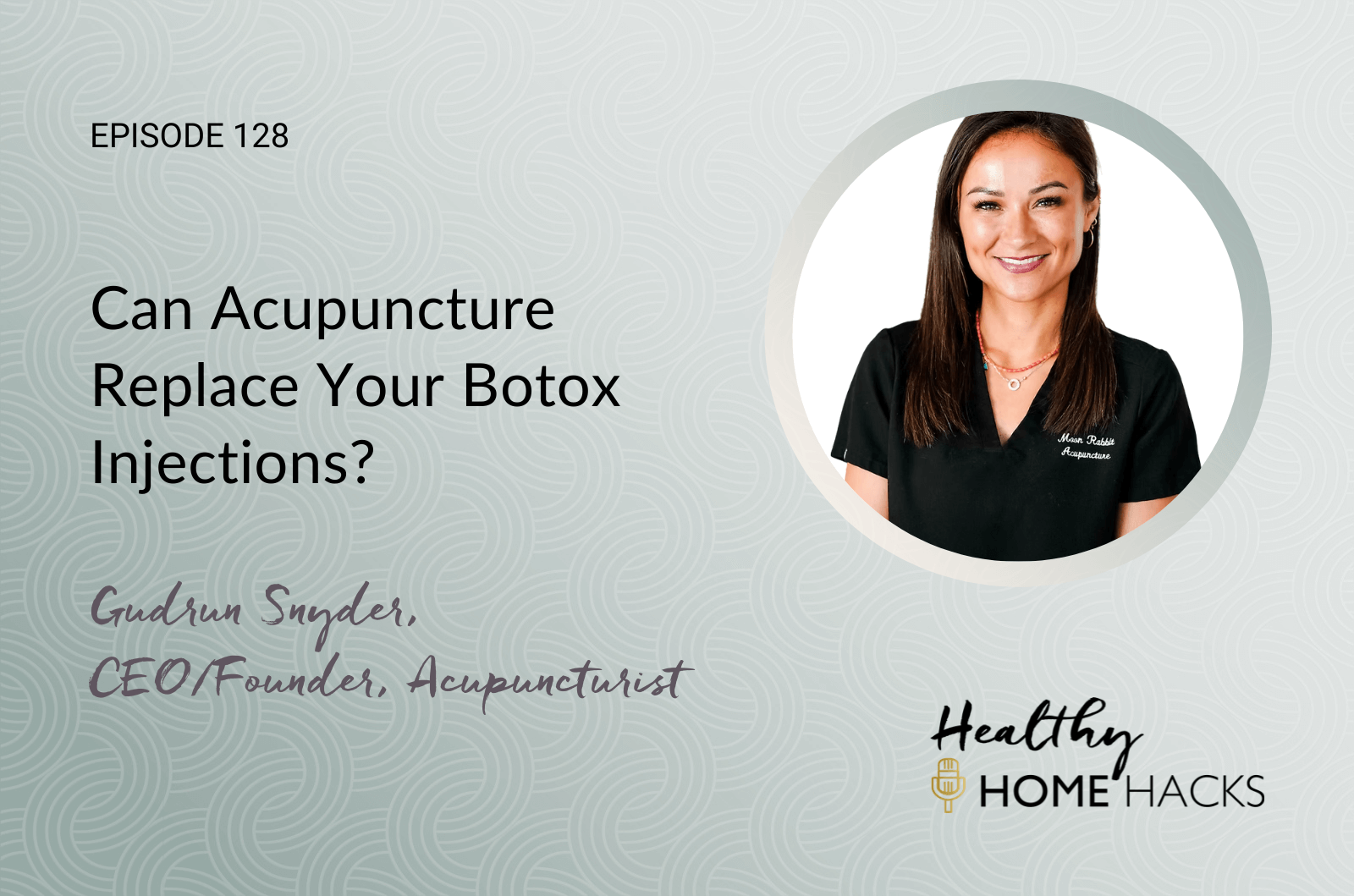

In this episode, we discuss Botox and the growing number of women choosing natural alternatives. Botox, or botulinum toxin type A, is a neurotoxic protein used in small doses to treat various medical conditions and to reduce wrinkles by temporarily paralyzing muscles. While millions of people have used Botox, it comes with potential side effects like bruising, headaches, muscle weakness, and, in some cases, more serious complications such as botulism. Most people are unaware that Botox carries a Black Box Warning issued by the FDA, which states that Botox can cause serious side effects, including the potential spread of the toxin from the injection site. This warning is the most serious type issued by the FDA.
Today, nearly 40% of women seeking anti-aging treatments are now exploring natural alternatives to Botox. Gudrun Snyder, a Doctor of Acupuncture and Chinese Medicine and founder of Moon Rabbit Acupuncture and a leading expert in cosmetic acupuncture, discusses Facial Rejuvenation Acupuncture—a holistic, non-invasive alternative that smooths fine lines, firms skin tone, treats acne, and boosts collagen production, all without synthetic injections.
KEY TAKEAWAYS
- Gudrun shares her healing journey as a breast cancer survivor who was diagnosed at the age of 32, with a 1-year-old baby
- What caused Gudrun to focus on Facial Rejuvenation Acupuncture
- The pain level of the treatment
- Can Facial Rejuvenation Acupuncture accomplish what Botox can for fine lines and wrinkles?
- The potential dangers to women using Botox
- How listeners can find a practitioner who specializes in Facial Rejuvenation Acupuncture
EPISODE LINKS
- To learn more about Gudrun and Moon Rabbit Acupuncture, visit https://www.moonrabbitacupuncture.com
Listen to all episodes of Healthy Home Hacks on your favorite podcast app
iTunes Spotify
Rate, Review, and subscribe on Apple Podcasts
“I love Ron & Lisa and Healthy Home Hacks.” <– If that sounds like you, please consider rating and reviewing our new show! This helps us support more people — just like you — to regain their health, protect their loved ones, and enjoy more energy. Click here, scroll to the bottom, tap to rate with five stars, and select “Write a Review.” Then be sure to let us know what you loved most about this episode or the entire show.
Additionally, if you haven’t already done so, please subscribe to the podcast. Subscribe now!
As always, we appreciate you subscribing to the Healthy Home Hacks podcast and taking the time to leave a review. Five stars are always appreciated if you find our show useful or just plain entertaining. Until next time – stay healthy!
FOLLOW RON AND LISA:
RonandLisa on Instagram https://www.instagram.com/ronandlisa/
RonandLisa on TikTok https://www.tiktok.com/@ron_lisa
RonandLisa Healthy Living Store https://shop.ronandlisa.com/
(00:05) How would you like to improve your health and keep your family safe? You're listening to the Healthy Home Hacks podcast, where we firmly believe enjoying optimal health shouldn't be a luxury. Healthy Home Authorities and husband and wife team, Ron and Lisa, will help you create a home environment that will level up your health.
Enter your name and email address below and I'll send you periodic updates about the podcast.
(00:25) It's time to hear from the experts. Listen in on honest conversations and gain the best tips and advice. If you're ready to dive in and improve your well-being and increase your energy, you're in the right place. All right, here are your hosts, bow biologists, authors, media darlings, vicarious vegans, and avocado afficionados, Ron and Lisa Bareris.
(00:49) >> Welcome to the show, everyone. I am Ron, and as always, I'm joined by my co-host and wife, Lisa. And today we're going to be talking about beautiful, youthful skin, but with a different approach that you might not expect. >> That's right. We're discussing Botox and the growing number of women choosing natural alternatives.
(01:11) Botox or bachulinum toxin type A is a neurotoxic protein used to treat various medical conditions and used to treat wrinkles by temporarily paralyzing muscles. Now, while millions of people have used Botox, it comes with potential side effects like bruising, headaches, muscle weakness, and in some cases more serious complications such as bachelism.
(01:34) Symptoms of bachelism may include blurred vision, drooping eyelids, slurred speech, and difficulty breathing, which can occur if the toxin enters the bloodstream. Most people are completely unaware that Botox carries a black box warning issued by the FDA, which states that Botox can cause serious side effects, including the potential spread of the toxin from the injection site.
(02:01) This warning is the most serious type issued by the FDA. >> Now, here's something fascinating. Nearly 40% of women seeking anti-aging treatments are now exploring natural alternatives to Botox. Which is why we're thrilled to welcome Goodren Snider, a doctor of acupuncture and Chinese medicine and founder of Moon Rabbit Acupuncture.
(02:26) Goodrin specializes in facial rejuvenation acupuncture. A holistic, non-invasive alternative that smooths fine lines, firms skin tone, treats acne, and boosts collagen production, all without synthetic injections. >> Now, the technique uses energy highways in the body that when stimulated encourage your skin to rejuvenate from within. Good.
(02:52) We're ready to learn how cosmetic acupuncture works. >> Inspired by a family of doctors and her grandmother that practiced traditional Chinese holistic healing. After attending Stanford business school, Goodran earned her doctorate in East Asian medicine. >> Combining her business knowledge with her passion for wellness, Moonra Rabbit Acupuncture was born.
(03:14) Welcome to the show, Goodwin. Yes. >> So happy to be here. Thank you so much. I'm thrilled to talk all things Botox and alternatives that can be natural and good for you like cosmetic or facial rejuvenation acupuncture. >> Well, we are ready to listen. Yeah. Right. >> Yeah. We've been dabbling into this on our show. It's such a hot topic.
(03:34) I'm seeing so many women including myself say enough is enough. We don't want to be slaves to these toxic procedures. We want this stuff out of our body. It's not all it's cracked up to be. And we're going to get into that today and what the dangers are and the alternatives. So, we are so happy to have you with us and I just want to dive right into your background a little bit because I read that you're a breast cancer survivor and were diagnosed at the age of 32 with a 1-year-old baby.
(04:02) Can you share that experience with our listeners and how acupuncture and Chinese herbal medicine helped you heal? Absolutely. So, part of my story as a healer, as a mother, and as a patient comes that my first round with breast cancer happened when I was in my early 30s. As you said, I had a one-year-old baby.
(04:21) I actually had just finished breastfeeding for an entire year, and I noticed a dimple in my right breast. Now, most people don't know a dimple as a sign of breast cancer, but because of my training in Chinese medicine, I did. And I proactively sought out my OBGYN. She said, "You know, I don't even really see it, but I believe you.
(04:41) Let's get a mamog right away." I went in and things moved very quickly. I was very lucky the first time around. I was only stage one recurrence this past year and had to go through all of the treatment again and I now have a fabulous chemo cut but I'm on the path to healing. Oh, that's good to hear. May I ask what stage it came back as? So, I'm stage two now because not only spread it came back but also it spread to my lymph nodes. Okay.
(05:11) because I have heard and I can't 100% with accuracy state this but if when cancer comes back it always comes back at a higher stage. Is that true? Well, it really depends. There's a lot of different ways of talking about it. Sometimes they actually won't even stage a recurrence because they typically only stage if it is a new cancer because unclear whether mine was a new cancer or not.
(05:35) They stage two because it wasn't just localized. It had spread to the other parts of my body, but not any organs. That would be >> Oh, thank goodness. Yeah, we've been through this with family members. And it's really scary. And like you probably were told, you're great. You're cancer free.
(05:53) Go on your merry way because that was a while ago. I don't know how old you have to say how many years. But you know, it's funny you say that. So, I had been on essentially a hormone blocking medication called tmoxifen, which some people familiar with for 7 years. And, you know, I'm the epitome of health. I work in health. I exercise. I'm fit.
(06:11) All of those things. And so, my oncologist said, "You can go off the tmoxifen." Now, one year later, I found essentially a growing lump in my breast. So, there we are. I had gone off the preventative medication and back. Was it an estrogen positive cancer both times? Okay. So, we know a lot about this cuz we unfortunately lost our sister-in-law to breast cancer.
(06:36) for hers came back stage four the second time and estrogen positive and so you know for listeners we do a lot of shows articles you name it on estrogen dominance endocrine disrupting chemicals that are in our everything I mean everything cosmetics skincare your food plastics I mean you name it and so this is why it's the water you're drink it's really really important to be aware of that a lot of people are like ah that's just hype.
(07:05) It's no big deal. But no, those actually are very potent chemicals that mimic estrogen in your body. And when you hear of someone like gluten that has estrogen positive cancer, there's a correlation there. Right. So, >> absolutely right. And I think the best thing we can do is not only be proactive in our health, we should not just be reactive and should also use all the tools in our toolbox.
(07:31) Right? So, I did chemo, but I also did acupuncture. I also took Chinese herbs. And you know, in the context of what we're talking about today, when we're choosing natural versus maybe more medical, you know, choices about things, it's really important to weigh the pros and cons of each, right? >> Right. Yeah.
(07:48) You have to follow what feels good to you no matter what. Like not feel pressured by someone telling you what to do because you'll be your best advocate. So, did you change your protocol the second time? Like were you more natural with your approach or did you always >> first time around? I was very natural. I mean I even cut out all desserts for the past seven plus years.
(08:10) I hadn't had you know my kids would laugh like even on a birthday they're like well mom's not going to eat anything cake right and I've used natural hair care products natural skinincare all of those things for years. I had a very hippie dippy mom who was a little bit ahead of her time. So she even used natural cleaning products before it was a well a trend.
(08:31) She was very ahead of it. So you know we can only do so much. Sometimes it's a little bit of bad luck but at least I try to say I did as much as I could and I have to be happy with that. Right. >> Right. Of course that's all you can do. And did you have to do chemo both times or just first time I had a double masectomy and I was actually scheduled for chemo and they had something called the ankotyping o essay which is now part of standard of care.
(08:57) However, when I was diagnosed it wasn't. I opted to do it anyways and you get a score and essentially is a score from 1 to 30 and if you get a certain score it's either chemo is going to be effective for your cancer type or not. My score was right in the middle. ologist said, "You're young, you're healthy, there's no reason to think that you need to have chemo.
(09:18) " And we agreed together. And if I could go back in time, I don't know that I would make a different choice with the information I had. I think we best with the information we had to say no chemo the first time around. That said, when the cancer came back and you was like chemo, I was like, "Yes, I am." >> Oh, you didn't do chemo the first time? >> Not the first time.
(09:39) You did the masectomy and >> I did the masectomy and the hormone therapy. The first >> hormone therapy. Okay. >> Yeah. My heart goes out to anyone listening who's going through this. It's a physical, emotional, spiritual. Everybody around you goes through it. It's a family affair. Friends and family, everybody, you know, it's a huge thing to go through.
(09:58) And so, whatever we can do to reduce our toxic load, we're going in the right direction. Like, don't underestimate one action. As I tell everyone, get rid of those plastic water bottles. Stop drinking out of them. just that one action today can help you. You just don't know what the trigger point is going to be in your life.
(10:14) You know, I completely agree and I do also think aside from things like endocrine disruptors and you know utilizing less plastic and the things that we put into our body, right? I think the other thing that we really need to keep in mind is our stress level and our active engagement constantly. Technology has been a wonderful thing in many ways.
(10:36) However, it has made our nervous system always beat on. We are always checking our phones, our emails, our texts. There really is no real reset or stopping, right? And that's a big deal. I think our overactive nervous systems right now are part of the problem as to why breast cancer and other cancers are so much more common, especially in a younger population of people. Yeah.
(11:02) What is the stat now? The rates in the youth are so skyrocketing. They've never been this high before. They're accelerating like adults. So if you look at cancer in adults and cancer in teens and I think even 20s, it's skyrocketing. And I think you are right. I believe it has a lot to do with the stress, the pressure, and of course electromagnetic radiation, always around Wi-Fi, always around wireless devices.
(11:25) And these teens, I say this a lot, Ron and I, but I'm going to say it again. Turn your cell phone off at night. Put it in airplane mode at a bare minimum because when you sleep and you're using that as your clock and you're talking to your friends late at night, you are getting exposure all those hours that your body should be healing and resting and that's really the only time that you get to do that is at night.
(11:50) So that's just another reminder and I'm sure you agree as a mom. I think it's so important to take that break, right? So good as part of your healing process, is that what caused you to focus on facial rejuvenation acupuncture? >> You know, so I've always been someone who like prides herself in the way I show up.
(12:08) So that's the way I show up with my energy and that's the way I show up with the how I'm presenting myself, right? I believe that our outside is reflective of how we take care of ourselves and our insides. So facial rejuvenation, acupuncture was a way for me to get trained in something that I'm like, you know what? I want to have good skin for as long as I can.
(12:26) I want to age in a healthy, healthy way. And so now I'm able to offer it for myself. >> Right. >> Can you do it to yourself or you mean? >> Yeah, I can do it to myself. I don't do full body acupuncture. And really, if you came to see me as a patient and you were getting facial rejuvenation acupuncture, you would always get a full body treatment because you do need to treat the whole body to have.
(12:46) >> Oh, you do. You can't just do the face. Don't just do the face. However, for me, I just do my own face and then see someone else for my body. >> Oh, gotcha. Okay. I'm so needle adverse. And you know, it's weird because >> you're not alone. >> I've got I've gone in and out of acupuncture. >> Like it's weird for me because like sometimes I'll be like, "Oh god, this doesn't hurt at all. It's nothing.
(13:08) I love And then bing, you know, you'll get like a ting sometimes in a certain spot and then I'll just obsess over that and then I get sweaty and nervous. I don't know if I >> Wait, have you had acupuncture or not? >> Oh, yes, I have. >> Okay. Okay. I did it a lot, but I got just kind of freaked out.
(13:26) I just never like needles and I have a really hard time relaxing. What it is is I have a hard time just calming down. Well, I read online, oh, you know, a practitioner if they don't do it right, they could poke an organ. I couldn't get that out of my head. So I was like, ah. So there was recently something in the news about a football player who had a numoththorax, which is essentially like someone poked a hole in his lung.
(13:48) >> Oh. >> Getting ac they said they everyone thought it was acupuncture, but it really was dry needling. And what is when acupuncture is done by someone who is a not boardcertified licensed acupuncturist and not say you were doing acupuncture unless you were a licensed acupuncturist. So when you see dry needling that is completely different from acupuncture.
(14:12) We as acupuncturists know how to dry needle. It's trigger point and motor point needling. It's one of the many tools we have in our toolbox. But people who are do just doing dry needling don't have a quarter a tenth near close the level of education and training that an acupuncturist does. >> Okay listeners that's so important.
(14:28) Look for a boomer certified. Yes. >> What certifications in particular? So what organizations would you consider? Absolutely. So, when you're looking for an acupuncturist, the things you need to be looking for, are they a graduate level degree? It should be a master's or doctor level for an acupuncturist. Additionally, they should be licensed in their own state. Right.
(14:48) So, for example, to graduate from my program and to be licensed in the state of Illinois had to complete 3,000 hours of clinical training. That's >> that's a lot of hours. Yeah. >> Right. And then I'm also board certified by the national it's the NCCOM. It's essentially our national board. And so I had to take board exams.
(15:05) I had to pass those. I have to keep up with my CEUs and continuing education. And so everyone who works at Moon Rabbit is not only licensed, they are also board certified. And so you need to be looking for both lensure and board certification. >> Okay. That's very good. Ron's mom used to work there actually in DC. Right. >> Right. She did. So yes, a while ago.
(15:25) It's funny that she did work there because she was not necessarily doing the practice of that. She just worked somewhere in executive office. One of her best friends was >> Yeah. One of her best friend was the CEO of the organization. >> Yeah. Yeah. Yeah. >> Thank her for her service to our industry. I think >> I know it's awesome. Yeah.
(15:41) She didn't know anything about acupuncture, but she was more on the administrative side, but people, right? >> Yeah. >> Absolutely. So, that was great. That was a while back, but for sure. >> When you get acupuncture in the face, is it painful? Can it be? You know, so you were saying some things that like, oh, it's painful. I get the cold sweats.
(15:58) It really matters who you go to. There are actually people who are like, so I'm extremely gentle. I'm probably the most gentle in my practice, unusually gentle for an acupuncture. Some people I like I put the needle and they're like, wait, did it happen yet? Right. But there are other acupuncturists who have a more intense technique.
(16:15) And some people want that. I was seeing one of my patently. She's like, I don't feel anything. I have to feel to heal. >> You're like, no, you don't. To answer your question, like is facial rejuvenation acupuncture like painful? The general answer is no. So like if you've ever gotten micro needling, that's painful. I do not.
(16:36) No, you don't need to numb the face because it doesn't feel like that. You're going to feel it going in, but it should feel like a temporary prick and then your whole body should relax because if you're with an experienced acupuncturist, they should be putting in additional acupuncture points that help your nervous system relax before they even touch your face.
(16:56) >> Yes, that's a good point. And so what would be like is it every part of your face? >> Yeah. How many needles and like how big are the needles? Yeah. >> Would be on your nose or like around the needles that you get in the doctor's office are like 30x times bigger that you're going to >> Yeah.
(17:12) These are like what are they like this big would you say? >> They're like tiny tiny. They >> tiny tiny. Some of them are even just the size of your fingernail. Um and thinner than a fingernail in terms of their actual width. So, in terms of how many needles that go in your face, it depends on who you've been trained by and then also your style.
(17:30) So, for example, for me, I probably put in about 30, but I know acupuncturists who put in closer to 60 to 90 needles. >> Okay. Probably better to start small and then work. I've had them in my ear and I kind of like that. That didn't hurt. I've had them in my head and that didn't surprisingly hurt at all.
(17:47) And so, I didn't >> any go in your lips like your lips or your nose? >> So, I've actually done some lip enhancing treatments. So some people instead of getting fillers you can do that. It is much more temporarily but essentially you line the lips with needles. That experience though I will say is more intense and I don't recommend it for everybody.
(18:04) You have to kind of >> because that's very sensitive >> but it works. It does. It will make your lips look a nice little pouch. And so the way that the needling actually works is that it creates micro traumas in your skin and then your body's own healing mechanism kind of fits it back together creating more collagen elastin.
(18:21) So, not only that's what creates that youthful look, but also that more full look. >> Yeah. Probably good for people with smoker's lips that get these grooves. I have a friend that complains about her upper lip because she exercises a lot and she goes >> and Oh, you are. It's created a lot of like wrinkles above her lips that she hates.
(18:43) So, I'll have to send her this episode. I talked to some of my patients about this too cuz one of the other trending things going on right now is like face yoga and whether or not it's effective and I say that if you held your face in one position for a long time just like your friend while she's running you're going to change your face and so if there are things that we can be doing on the daily whether that's gouasha facial yoga whatever it is that will also change your face right yeah oh I have to ask you because I just had the most amazing treatment and I know you're
(19:12) probably going to be familiar with it. It's called Bojan. >> No. >> Oh, okay. You'll have to look it up. It's rooted in Chinese medicine or Chinese aesthetics. It's really lymphatic drainage for your face, but they use this tool and it's pretty aggressive. It goes in there and like I mean, I thought it was just going to be like a gouacha, but it was pretty rigorous.
(19:34) And I mean, you feel like really deep into your face muscles and your bones and they'll do like some facial bone. Yeah, it's pretty little >> might be similar to what's Japanese massage which is like kubigo massage and that also sounds very similar to what you're discussing which I love. I've loved it. It's not like your most relaxing facial I will say.
(19:54) No, but it's effective. Give me the work. Right. I want to walk out of there with my glow. And that's the other things that I will say over Botox or fillers or something like that. You go in and get your facial acupuncture. You can walk out and go to a gala, right? Like >> Oh, yes. Right away. >> Right away, you're not going to be red.
(20:13) No redness. >> I mean, if you're someone who gets hyperpigmentation or is very hyper sensitive in general, you might be red, right? That's just a possibility. But for the general population, I would say 80% plus, like you can go and do your normal day and no one will even know what you did earlier that day. >> Wow. Okay. And that's great.
(20:31) That's great. >> That kind of is kind of a segue to my next question. So, how many sessions would you need to accomplish what Botox can with the fine lines and wrinkles? Are you looking perfectly all set up after you complete the session or does it take multiple? >> I doubt it. We'd all be have done that already. >> The facial acupuncture will never get you the same results as Botox.
(20:52) And if someone is telling you that, you're lying to you. So, Botox freezes your face, right? Whereas facial acupuncture actually relaxes your face and works in a completely different biological mechanism than Botox does. Right? We talked a little bit about the micro traumas. We talked a little bit how like collagen and elastin get rebuilt.
(21:10) Botox doesn't do any of that. It simply just makes your muscles not move. Right? That's what it paralyzes your muscle. It >> paralyzes it, >> right? versus cosmetic acupuncture relaxes your muscles just like facial yoga puts your muscles into like the best position so that over time you get better results.
(21:28) That's what facial acupuncture is going to do for you. If you are young and you are 20 something years old, you can have one treatment and it's going to do the thing for you. So you're older and you want more significant results. This is a subtle result type of therapy. You're going to need more and more frequent therapies. But again, because acupuncture is such an individualized medicine, we will meet where you are and tailor the treatment to you. Nice. Nice. I love it.
(21:55) You know, what is your opinion on Botox? I mean, we talked at the top the the risks that nobody talks about. A lot of women don't even know. If you meet me at a party or an event, I'll get you in a corner and tell you all about it. But people women look at me like, "What? I didn't know that. Blackbox warning.
(22:12) How come I didn't know that?" Oh, because your injector didn't tell you because you didn't see the box. You only saw a needle and so you're not told any of that. Very much gaslighting in that industry. I think I think it's really important to be an educated consumer. For me, I think asking questions and finding the right treatment for you.
(22:29) You said that a little bit about this in the beginning. It's like whatever you're comfortable with. If a patient comes to me and asks me, "What do I think that she got Botox?" I say, "I'm glad you got Botox. Just make sure that like you're educated on where you're getting it from and where how they're doing and what they're using.
(22:45) Right? You can also do Botox at the same as cosmetic acupuncture. This is not an eitheror. This is not one is significantly better than the other. They are totally different categories in my mind. Right. someone who wants a medical grade treatment that will freeze their face so they do not >> acupuncture is a full body rejuvenating treatment that will help you look and feel your best like with glow from within and will be subtle results over time so that you age gracefully.
(23:15) These totally different things but can work in tandem to together if you want to. >> Yeah. And I would say the main difference between the two is one is comes with potential side effects and one doesn't. I mean, >> that's like also true. >> That is very true. And we're not putting anything into your skin.
(23:33) Like, we're not anything. The the needles we use are medical grade needles that are one time use and we throw them away. The risks are just significantly different. And you have to assess your own risk profile for what you are willing to do and be educated. Be an educated consumer. >> I have a question.
(23:48) So, I know during a full body acupuncture session, I remember a lot of times the needles going in between your finger and your thumb like right in your hand, right? >> Yeah. Where where's the go-to place on the table for the facials? So, you're laying there hitting them right in the nose when they start or where does it start? >> I don't need no.
(24:06) >> But I actually start with needles in your feet to ground you and make you feel really really settled in. And that's going to really help bring you down from the awareness of your face to your body. Then I'll put some needles probably around your chest area to kind of bring you to your heart center. Someone hands because the hand point that's between your thumb and your pointer finger and that fleshy mound area right there, that's the command point for the head and face.
(24:33) >> Oh, is that what that is? Okay. Clear your sinuses, treat headaches, and get your whole face to open up to what we do next. And the needles in the face. And they will go everywhere. They will go in the top of your head. They will go in your eyebrows. They will go on the sides of your nose.
(24:48) They will go on the sides of your lips. They will go along your jawline and behind your ears for that kind of snatched jaw look. >> Oh, right. So, you put them in the neck, too. >> We can put them on the neck. I only put them on the neck for people who ask for them. It's part of my standard protocol, but I'm always happy to do it.
(25:04) Everyone just has a different like and I always want to meet people where they are for their goals. >> Yeah. Wow. So, going back to fillers and Botox, and it sounds like you're very much like, "Hey, you do you, you do you, but be educated when you do you." >> Yeah. Yes. Like, the other thing I'll say, cuz I've gone down this rabbit hole a lot this last year.
(25:25) Well, one thing I learned, Ron and I are vegan, so we don't eat any animal products, right? And we're very clean eaters. Everything organic whenever we can. But I found out that Botox and a lot of the other brands under that name use human blood albamin. So it's a protein from humans that is used in there.
(25:45) And that's another thing that people aren't told. And I've talked about it on another episode, but I thought it was so important to mention that because that's not told to you. And that to me is a big deal. Like you should be told that 100%. And here's the thing. In America, that is not how our medical aesthetic, any of our systems work, right? There is no major list of ingredients made out to you in front of your face or even talked through.
(26:09) Maybe it's in fine print, but it's not even always in fine print to be. >> Yeah. You don't get a pamphlet when you go out. >> It is on ownership of ourselves in a time that we are living in to be proactive and educated about our health. This is our bodies and we have a right to know what goes into it. But it the ownership has to be on us because we are not living in a world where information is shared freely. It's it's fortunate.
(26:33) It's I wish that that was not the case. But because it is, we have to work under that system. And you're absolutely right. There are additives and things that we don't know about. There are animal, human, etc. products and do not know about. And we need as consumers to be educated, informed, and proactive. Right.
(26:52) >> Yes. It's unfortunate that it falls on the consumer like you said, but I think we could take that across every industry. I mean, whether it's your mattress that you're shopping for and you're not being told what flame retardants are in there or your cleaning product that doesn't fully list the ingredients on the label or your skin care that's hiding the ingredients under the word fragrance or on and on and on and on on and on and on.
(27:17) And as they were saying too, I actually had an experience with like an IV therapy place where I trusted them. I knew them, they knew me because of my reputation in the community and they invited me in. And I got an IV only later to find out it had other things in it than I was essentially told. And I was really upset as a person is a cancer survivor, as a person who lives in holistic wellness.
(27:43) And I confronted the owner about it and brought my concerns and she acknowledged some level of fault but not full. Right? Again, even me, I consider myself an educated consumer was not proactive enough to be like, I need a full list of ingredients here. I should have asked for them, right? I absolutely a learning moment for me.
(28:03) >> Yeah. What was in it? Essentially, they were like heavy metal like additives and things that are often can be co-actors or co-enzymes that help the body either absorb, but I don't want any of those things in my body. >> No, we're working hard to get them out. Like, it's a lot of work to get them out. That's exactly right.
(28:20) And so, for me, that was not the right thing for me. But I also didn't ask. And again, it was a learning moment. We must ask. We have the right to ask. We have the right to ask. I think there's an energy sometimes when you go to places that you feel guilty asking. you kind of feel like smoothly, right? It's this just energy like Ron, we had someone on and she talked about the IV therapies that they can have a lot of animal products and at that time we had gone a couple times to get like a vitamin boost, you know, if we're under the weather or B shot or
(28:49) whatever. And she's like, "Yeah, you have to ask cuz a lot of them will have animal products." And you're like, "What? I never thought of that in an IV or B, right?" But it makes sense if you think of like you have to be careful when you buy supplements. Oh my god, supplements are so dangerous. You have to check what's in them and it's not always going to be in the bottle because as you know that it is not a regulated like area.
(29:12) You have to get them from a company and almost a person that you trust. And then again to what you were talking about this kind of energy like we are afraid to ask because either we feel intimidated, there's white coat syndrome, right? We're like someone as a superior and educated so we just assume that they are taking care of us.
(29:28) That is not always the case, right? Time in our lives where we again need to not be afraid to be like, I'm protecting myself. That's okay. Yeah. Or they'll tell you one ingredient like this happens a lot. Like let's say fillers. Oh, it's hyalonic acid. It's what your body makes naturally. Okay, that's true. But I want to know where does that hyalonic acid come from? Is it synthetic? Is it coming from an animal? What are the additives? Right.
(29:53) And so, yeah, I think that's a little of the gaslighting there, too. people are leave thinking, oh, it's all natural and it's coming from what my body makes, you know, and you're like, wait, there's more to that story. So, yeah, being an informed that people have for all of these things, everybody wants a lot of these things.
(30:11) So, now there's more providers and more suppliers, which mean things are also diluted down in the information pathway that a lot of these people who are supplying it don't even actually know the answers. >> Yes. Yes. I've had that where I've asked and they're like, I don't know. Let me go check and then 30 minutes. Yeah, >> too many things and no longer is it like the expert in the field offering the thing.
(30:33) It's everybody can you there's a med spa in every corner in >> there's every corner especially here in we're in Orange County, California. It's like you know land of the med spa and you have people doing injections that shouldn't be right. So that's going back to your board certified acupuncturist. The same goes for fillers. Like a doctor's the best.
(30:51) Obviously a board-certified doctor would be ideal. Not a lot of people are going to doctors or going to nurses. And even at that, there's levels, right? There's a nurse practitioner, there's an RN, there's a, you know, an LPN. I don't know if they can even do it, but you've got levels within that.
(31:06) And so, I think experience is really important, too. In addition to educating yourself, making sure you have to vet it. Like you said, it's your body and everything that we put into it does matter because we have an ecosystem that needs to work together and you just don't know, right? or if you're going to allergic reaction to something, right? Absolutely.
(31:25) Absolutely. >> Yeah. >> This is off topic, but has acupuncture been used to try to help cure cancer, for example, or certain types of >> Historic times, 3,000 years ago before we had chemotherapy and radiation therapy and all the things like that. Entire scope of medicine. So, they have acupuncture points to treat things like cancer.
(31:45) Though I will say to those of you who are suffering from cancer or you know a diagnosis in therapy, please use all the tools in your toolbox. Something that is just a natural energetic alternative is not necessarily a cure. It is an adjunct of therapy. It is something that you should be doing in addition to all the other things that you should be doing under a physician's recommendation.
(32:06) So maybe not cancer, but are there some illnesses like maybe arthritis or something too that there's documentation that shows that acupuncture certainly can address and help heal that? >> Absolutely. Acupuncture is this wonderful magical tool that is significantly underutilized in the United States. We treat everything from like the common things that you know about like back pain, maybe people know about getting pregnant with acupuncture, but we also have >> Yes, that's a biggie, right? I have this other patient that had like a mold
(32:33) toxicity problem and I helped him get through the autoimmune disorder that had come from that with acupuncture because acupuncture treats inflammation so so well. There's other things that people don't know about. I mean most people know about migraines and headaches that it treat but also some people have treated their asthma with acupuncture, right? Their depression and getting off their medications.
(32:56) They really have to do it with someone who knows what they're doing. >> Yeah. Well, speaking of headaches, I think that's a great point because a lot of people are using Botox for headaches. And I saw this doctor, she had a video and the patient was like, "Oh, I get migraines." And the doctor's going, "Okay, well, we're going to put Botox all the way around the head and then we're going to put it all the way down your back and then we're going to put it in your back.
(33:15) " And I'm watching this going, "That is a lot of Botox. I mean, how can that you're going to have to do it forever." The thing that we do as acupuncturists, which I think is unique to our type of medicine, is that we don't want to necessarily keep you forever. We want to fix the thing that is important to help you with, whether that is your migraines, whether that is chronic fatigue, and then if you want to come back and visit us, we'd love to see you, but you won't need to see us forever because those things should no longer be an issue for you.
(33:47) >> Yeah. >> Like a real doctor. like a real healer. We absolutely want to heal you. So that you're dependent on us forever, right? A novel idea today. And it's shocking some people who've had like they've gone to the neurologist and this and that and no one can help and they're like, I'm just here because my friend told me to come in and I don't even think this is going to work.
(34:08) And I'm like, why don't you just give me three sessions? And they're like, my god, why didn't I not come earlier? This life changing. >> I'm telling everyone. And it's a wonderful thing, right? Yeah, because acupuncture has been around for how many years? Thousands, right? >> 3,000 years acupuncture has been around.
(34:22) And so 3,000 years. >> 3,000. Yeah, that's pretty telling. And I think like with the chi energy, obviously I know a bit about it. And when you have stagnant energy in your body from stress or sitting too much or overworking or not sleeping or eating or whatever is causing your stagnant energy, how else are you releasing that? Obviously, massage is good, but obviously that's the underlying part of acupuncture, right? You're getting the flow of your body's energy.
(34:51) >> Energy of your body, your chi. It also works with the fluids of your body. But it also has biochemical underlying pathways that it also works on. It helps reduce the inflammatory markers and cytoine storms that are involved in inflammation. It also reduces high cortisol. But cortisol is not always a problem. I want to put that out there.
(35:10) This whole like cortisol myth thing. You need cortisol to be healthy. So don't get rid of the fall in your body. >> Okay, that's important. Yes, I don't like cholesterol. I've been reading how good cholesterol is actually. >> All of these things, right? And so we are learning now about the biochemical like actual mechanisms of how acupuncture works, but at the end of the day, it's been around for 3,000 years for a reason and we can it really works.
(35:37) >> Nice. And I love that you come from a family of, you know, ancient, were they acupuncturists or just in Chinese? >> Oh, my family, my dad, he was first generation here. He was a physician and a family medicine physician. He had acupuncture charts on his walls. He actually went to China and got all the acupuncture guides and things like that and gave them to me when I was younger, which I think is so beautiful.
(36:00) My grand from Shanghai, she was an ear, nose, and throat doctor. But when you in either China and even other countries like France, being an acupuncture actress can be a part of your medical curriculum, right? In other countries, you actually have to be an MD to be an acupuncturist, right? >> Oh, and she's a doctor.
(36:19) She was familiar with acupuncture, herbal medicine, all of that. And she lived to over a hundred years old and was one of >> all the cognitively there humans that I've right >> no processed foods. I'm sure >> it was a little different. >> All right. Well, how can our listeners find a practitioner in their area because you're in Chicago that specializes in facial rejuvenation acupuncture? The best thing to do is first ask your friends.
(36:45) I think that looking to your trusted group of people is always the first place you should ask for anything that you're trying to find. Then you can go to the NCCOOM's website and look for a board-certified acupuncturist near you. Then once you find a person near you, the thing you need to ask for is certification, right? Not only am I trained in facial rejuvenation, acupuncture, I'm actually certified in it, right? And additional training beyond just my acupuncturist training and that's the additional piece that you want to look for.
(37:16) >> Okay. Because is it a new thing or has it been around for a while? >> The answer is yes, but it's newer because it is more utilized and definitely more in trend. But facial rejuven acupuncture has been a part of acupuncture for hundreds of years, right? >> Okay. Yeah. Just gained popularity as a natural alternative, which I love and gouacha, which I also love.
(37:37) We both do gouacha. We do gouache a lot. It did this morning on my face. I had a puffy eye. I was like, "Oh, I got to do my gouache before I go out." >> And it worked. >> Works. Great job. >> It worked with no puffiness. Yeah. It's a pretty incredible little tool that you can just do while you're watching a movie or you can do it anywhere. Yeah.
(37:55) That's great. Well, is there any last words of wisdom you want to leave with our listeners with? >> I want to say it's okay to ask questions, educate, empower yourself, and make the choices that are right for you. Yes. Very good. Well said. Educate, educate, educate, you guys. And thank you so much for being with us today, Goodrin.
(38:16) You can learn more about gluten and moonrabbit acupuncture at moonrabbit acupuncture with one c.com which we all get that one wrong. And you can find all the links in the show notes at healthyhomehacks.com. >> Absolutely. And as always, please rate and review our show. Five stars are always appreciated. Check for Healthy Home Hacks podcast and go to your favorite place where you give us a fivestar rating so you can have all these stellar guests like we provided you today in the future.
(38:46) So here's to great health and wellness. Bye everyone. Thanks for your time. >> See you next time. >> Thank you. >> Thank you. This episode of the Healthy Home Hacks podcast has ended, but be sure to subscribe for more healthy living strategies and tactics to help you create the healthy home you've always dreamed of.
(39:10) And don't forget to rate and review so we can continue to bring you the best content. See you on the next episode.
Sign up to receive email updates
Leave a Reply